
Acta Iuris Stetinensis
Wcześniej: Zeszyty Naukowe. Roczniki Prawnicze
Statystyki OpenAlex
Dla całego czasopisma, według OpenAlex.
- Cytowania
- 292
- Publikacje
- 762
- H-index
- 4
- I10-index
- 2
- Średnia cytowań (2 lata)
- 0,03
Pokaż dane w tabeli
| Rok | Publikacje | Cytowania |
|---|---|---|
| 2017 | 56 | 12 |
| 2018 | 47 | 12 |
| 2019 | 55 | 6 |
| 2020 | 38 | 40 |
| 2021 | 76 | 33 |
| 2022 | 87 | 36 |
| 2023 | 67 | 40 |
| 2024 | 85 | 23 |
| 2025 | 58 | 46 |
| 2026 | 45 | 21 |
Dane pobrane:
Co oznaczają te liczby?
Publikacje i cytowania obejmują rekordy powiązane z tym czasopismem w OpenAlex. H-index to największa liczba h publikacji mających co najmniej h cytowań. I10-index to liczba publikacji cytowanych co najmniej 10 razy. Wykres przedstawia cytowania otrzymane w danym roku; bieżący rok jest niepełny. Zakres bazy może różnić się od WNUS i innych serwisów.
Średnia z 2 lat jest wskaźnikiem OpenAlex. Nie jest to Journal Impact Factor firmy Clarivate.
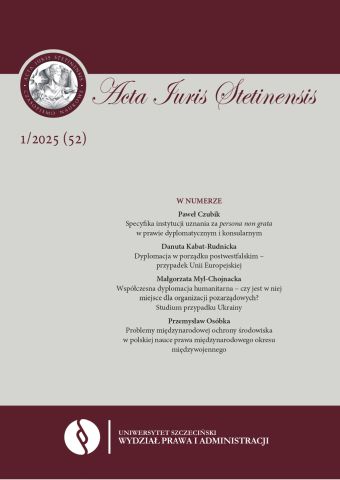
Dyplomacja w porządku postwestfalskim – przypadek Unii Europejskiej
DOI: 10.18276/ais.2025.52-02
Cytuj
Pełny tekst jest dostępny
| ISSN: | 2083-4373 |
| eISSN: | 2545-3181 |
| Autorzy: |
Danuta
Kabat-Rudnicka

Uniwersytet Ekonomiczny w Krakowie |
| Redakcja: |
Redaktor tomu / Volume Editor:
Ewelina
Cała-Wacinkiewicz
Uniwersytet Szczeciński (Polska) / University of Szczecin (Poland) |
| Słowa kluczowe: | porządek postwestfalski dyplomacja Unia Europejska Europejska Służba Działań Zewnętrznych |
| Data publikacji całości: | 2025-03 |
| Liczba stron: | 16 (25-40) |
| OAI-PMH: | Metadane |
| Cited-by (Crossref) ?: | Włącz JavaScript, aby pobrać dane cytowań. |
| Liczba pobrań ?: | 589 |

 

 
| |
Abstrakt
Dyplomacja jest tradycyjną domeną państw. Jednakże dzisiaj w świecie postwestfalskim, jest również skutecznie prowadzona przez aktorów niepaństwowych, w tym przez organizacje międzynarodowe. Takim niepaństwowym aktorem, i zarazem podmiotem prawa międzynarodowego, jest Unia Europejska. I chociaż gros działań Unii zamyka się w obszarze niskiej polityki, to jest ona również obecna na polu wysokiej polityki, prowadząc politykę zagraniczną. W coraz większym stopniu angażuje się w sprawy międzynarodowe, stąd też na znaczeniu zyskuje unijna dyplomacja. Celem artykułu jest przybliżenie aktorów niepaństwowych działających w obszarze dyplomacji na przykładzie Unii Europejskiej. W artykule zastosowane zostało podejście typowe dla nauki o stosunkach międzynarodowych i prawa międzynarodowego publicznego. Rozważania koncentrują się wokół takich kwestii, jak: ład postwestfalski, Europejska Służba Działań Zewnętrznych będąca narzędziem organizacyjnym dyplomacji unijnej oraz dyplomacja Unii Europejskiej. Przedmiotowe rozważania prowadzone są przy zastosowaniu metody dogmatycznej, analizy przypadku i komparatystyki prawniczej.
Podgląd PDF
Bibliografia (24)
- Adler-Nissen R., Theorising the EU’s Diplomatic Service: Rational Player or Social Body?, w: D. Spence, J. Bátora (eds.), The European External Action Service: European Diplomacy Post-Westphalia, Basingstoke 2015, s. 17–41.
- Austermann F., Representing the EU in China: European Bilateral Diplomacy in a Competitive Diplomatic Environment, w: D. Spence, J. Bátora (eds.), The European External Action Service: European Diplomacy Post-Westphalia, Basingstoke 2015, s. 288–305.
- Bátora J., The ‘Mitrailleuse Effect’: The EEAS as an Interstitial Organization and the Dynamics of Innovation in Diplomacy, „Journal of Common Market Studies” 2013, vol. 51, no. 4, s. 598–613.
- Bátora J., Spence D., Introduction: The EEAS as a Catalyst of Diplomatic Innovation, w: D. Spence, J. Bátora (eds.), The European External Action Service: European Diplomacy Post-Westphalia, Basingstoke 2015, s. 1–16.
- Bickerton Ch.J., European Integration: From Nation-States to Member States, Oxford 2012.
- Butler G., The European Union and Diplomatic Law: An Emerging Actor in Twenty-First Century Diplomacy, w: P. Behrens (eds.), Diplomatic law in a new millennium, Oxford 2017, s. 319–340.
- Duquet S., EU Diplomatic Law, Oxford 2022.
- Guimarães F.A., Speak up! Getting the EU a Voice at the UN General Assembly, w: J.A. Koops, G. Macaj (eds.), The European Union as a Diplomatic Actor, Houndmills–Basingstoke–
- Hampshire 2015, s. 88–102.
- Hocking B., Melissen J., Riordan S., Sharp P., Futures for diplomacy. Integrative Diplomacy in the 21st Century, Report, No. 1, October 2012, https://www.clingendael.org/sites/default/files/2016-02/20121030_research_melissen.pdf.
- Kleistra Y., Willigen N. van, Evaluating the Impact of EU Diplomacy: Pitfalls and Challenges, w: J.A. Koops, G. Macaj (eds.), The European Union as a Diplomatic Actor, Houndmills–Basingstoke–Hampshire 2015, s. 52–68.
- Linklater A., The Transformation of Political Community: Ethical Foundations of the Post-Westphalian Era, Cambridge 1998.
- Manners I., Whitman R., Normative Power and the Future of EU Public Diplomacy, w: M.K. Davis Cross, J. Melissen (eds.), European public diplomacy: soft power at work, New York 2013, s. 183–203.
- Onestini C., A Hybrid Service: Organising Efficient EU Foreign Policy, w: D. Spence, J. Bátora (eds.), The European External Action Service: European Diplomacy Post-Westphalia, Basingstoke 2015, s. 65–86.
- Pietraś M., Marzęda K., Późnowestfalski ład międzynarodowy, Lublin 2008.
- Raube K., Democratic Accountability and EU Governance: The EEAS and the Role of the European Parliament, w: D. Spence, J. Bátora (eds.), The European External Action Service: European Diplomacy Post-Westphalia, Basingstoke 2015, s. 140–156.
- Spence D., From the Convention to Lisbon: External Competence and the Uneasy Transition for Geneva Delegations, w: D. Spence, J. Bátora (eds.), The European External Action Service: European Diplomacy Post-Westphalia, Basingstoke 2015, s. 219–240.
- Spence D., The EEAS and Its Epistemic Communities: The Challenges of Diplomatic Hybridism, w: D. Spence, J. Bátora (eds.), The European External Action Service: European Diplomacy Post-Westphalia, Basingstoke 2015, s. 43–64.
- Teschke B., Metamorphoses of European territoriality. A historical reconstruction, w: M. Burgess, H. Vollaard (eds.), State Territoriality and European Integration, London–New York 2006, s. 37–66.
- The EU at the United Nations, September 2022, https://www.eeas.europa.eu/sites/default/files/documents/The%20EU%20at%20the%20United%20Nations.pdf.
- Unia Europejska, Europejska Służba Działań Zewnętrznych, https://www.eeas.europa.eu/_en.
- Weston A., Mérand F., The EEAS and Crisis Management: The Organisational Challenges of a Comprehensive Approach, w: D. Spence, J. Bátora (eds.), The European External Action Service: European Diplomacy Post-Westphalia, Basingstoke 2015, s. 323–340.
- Wouters J., Duquet S., Unus inter plures? The EEAS, the Vienna Convention and International Diplomatic Practice, w: D. Spence, J. Bátora (eds.), The European External Action Service: European Diplomacy Post-Westphalia, Basingstoke 2015, s. 159–174.
- Zieliński M., Charakter prawny i zadania Europejskiej Służby Działań Zewnętrznych, „Państwo i Prawo” 2014, nr 10, s. 85–97.