ISBN: 978-83-7241-459-9 ISSN: 0860-2751 OAI


Issue archive / T. (DCXXXIX) 565
| Year: | 2005 |
| Field: | Field of Humanities |
| Discipline: | literary studies |
| Authors: |
Agata
Zawiszewska

Uniwersytet Szczeciński |
Information
Date of release of digital version under CC-BY-SA license: January 2026
This file is a scan of the printed version of the publication.
Issue File
Abstract
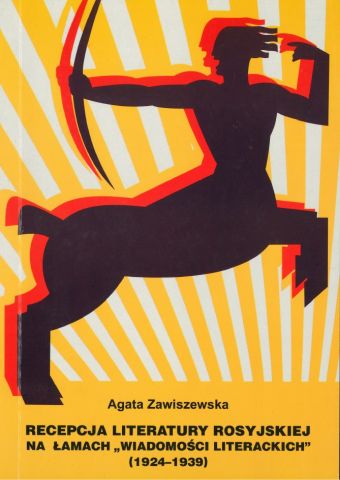
THE RECEPTION OF RUSSIAN LITERATURE IN THE WEEKLY WIADOMOŚCI LITERACKIE IN THE YEARS 1924-1939
Wiadomości Literackie, in English Literary News, was the best and most influential socio-cultural weekly of the period between the I and II World War. It was important not only because of the high level of publicist and literary texts which were put there but also because of the constantly propagated ideological and artistic programme. The weekly was the only then financially independent newspaper and that is why it could propagate liberalism. It popularised pacifism, tolerance towards people of other political views and beliefs as well as racial and sexual minorities. It was also for assimilation of the Jews and women's emancipation. At that time it was unique prÓgramme because the most influential then parties were Piłsudzki's Supporters and the National Conservatists. WL on the other hand, was the organ of intelligentsia, freelance people, people employed in the field of culture and education and clerks. WL was also the only then newspaper that constantly propagated foreign literature in Poland. The paper took especially a liking for the literature of 4 European countries: Soviet Union, Germany, Great Britain and France. Russian and German literature were watched by the prism oftotalitarian form ofrule of Stalin and Hitler. The writers of the weekly wrote the texts which suggested that the elite of Russian and German nations separated themselves from Fascism and Bolshevism and that it aimed at good contacts with Polish writers. In the newspaper, French literature was presented as worth imitating model of producing 1iterature culture. In English literature WL emphasised rationalism, distance to the world, liberalism and pacifism. Among the greatest European writers were, according to WL T. Mann, M. Proust, A. Gide, F. Mauriac, I. Bunin, A. Tolstoy, G.B. Shaw. Thus, foreign literature was used by WL to propagate a new model of an educated Pole. It not only objectively informed about the most significant foreign literary works and writers but also paid particular attention to the authors who suited the ideology of liberalism.
Translated by Agata Zawiszewska