
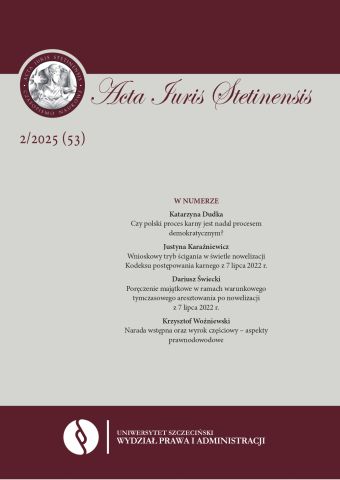
Acta Iuris Stetinensis
Previously: Zeszyty Naukowe. Roczniki Prawnicze
Udział tłumacza w polskiej procedurze karnej – trudności i wyzwania
(Assistance of a translator and interpreter in the Polish criminal procedure – difficulties and challenges)
DOI: 10.18276/ais.2025.53-06
Cite
Reference (APA 7)
Olesiuk-Okomska, M. (2025). Udział tłumacza w polskiej procedurze karnej – trudności i wyzwania [Assistance of a translator and interpreter in the Polish criminal procedure – difficulties and challenges]. Acta Iuris Stetinensis, (2 (53)), 79–98. https://doi.org/10.18276/ais.2025.53-06
The full text is available
| ISSN: | 2083-4373 |
| eISSN: | 2545-3181 |
| Authors: |
Magda
Olesiuk-Okomska

Akademia Wymiaru Sprawiedliwości |
| Editorial Board: |
Redaktor tomu / Volume Editor:
Hanna
Paluszkiewicz
Uniwersytet Szczeciński (Polska) / University of Szczecin (Poland) |
| Keywords: | criminal proceeding criminal procedure sworn translator sworn interpreter right to translation and interpretation foreigners |
| Issue / book publication date: | 2025 |
| Page range: | 20 (79-98) |
| OAI-PMH: | Metadata |
| Downloads ?: | 466 |

 

 
| |
Abstract
Although Polish is the official language before the judiciary, due to the dynamic development of international relations and the increase migration, foreigners, who do not speak Polish to a sufficient extent, are more and more often participating in proceedings before Polish courts, including criminal proceedings. Communication with these individuals and the use of documents prepared in other languages require the assistance of a translator or interpreter, the presence of whom ultimately aims at guaranteeing the right to a fair trial. The purpose of this study was to elucidate the regulations governing the position of a translator and interpreter, as an assistant to procedural authorities and the accused, as well as to highlight problematic issues associated with the practice of translating and interpreting in the Polish criminal procedure.
Preview PDF
Bibliography (13)
- Długosz J., Prawo do udziału tłumacza jako jedna z przesłanek rzetelnego procesu karnego, „Investigationes Linguisticae” 2009, vol. 17, s. 100–107.
- Gruszecka D., w: J. Skorupka (red.), Kodeks postępowania karnego. Komentarz, Warszawa 2023.
- Hofmański P., Prawo do udziału tłumacza jako jeden z warunków uczciwego procesu, w: E. Pływaczewski (red.), Przestępczość cudzoziemców. Nowe wyzwanie dla teorii i praktyki, Szczytno 1995, s. 51–62.
- Hofmański P., Prawo do udziału tłumacza w postępowaniu karnym, w: A.J. Szwarc (red.), Przestępczość przygraniczna. Postępowanie karne przeciwko cudzoziemcom w Polsce, Poznań 2000, s. 148–156.
- Nagao H., Sprawa z Melbourne: niewłaściwe tłumaczenie przyczyną oskarżenia o niepopełnione przestępstwa, tłum. Z. Rybińska, „Lingua Legis” 2005, nr 13, s. 3–7.
- Nowikowski I., Uwagi o zasadzie rzetelnego procesu karnego (kwestie wybrane), w: J. Skorupka (red.), Rzetelny proces karny. Księga jubileuszowa Profesor Zofii Świdy, Warszawa 2009, s. 45–56.
- Olesiuk-Okomska M., Wpływ regulacji Unii Europejskiej na udział tłumacza w polskiej procedurze karnej, w: I. Sepioło-Jankowska (red.), Reforma prawa karnego, Warszawa 2015, s. 506–516.
- Rogacka-Rzewnicka M., Znaczenie niepisanych reguł postępowania dla tworzenia podstaw rzetelnego procesu karnego, w: J. Skorupka (red.), Rzetelny proces karny. Księga jubileuszowa Profesor Zofii Świdy, Warszawa 2009, s. 92–106.
- Rogalski M., Res iudicata i zakaz ne bis in idem jako gwarancje rzetelnego procesu, w: J. Skorupka (red.), Rzetelny proces karny. Księga jubileuszowa Profesor Zofii Świdy, Warszawa 2009, s. 168–180.
- Skrętowicz E., Z problematyki rzetelnego procesu karnego, w: J. Skorupka (red.), Rzetelny proces karny. Księga jubileuszowa Profesor Zofii Świdy, Warszawa 2009, s. 21–27.
- Stachowiak S., Uprawnienie pokrzywdzonego do korzystania z pomocy tłumacza w polskim procesie karnym, „Prokuratura i Prawo” 2000, nr 12, s. 7–14. Stefański R.A., Udział tłumacza w postępowaniu karnym jako przejaw rzetelnego procesu karnego, w: J. Skorupka (red.), Rzetelny proces karny. Księga jubileuszowa Profesor Zofii Świdy, Warszawa 2009, s. 360–392.
- Wiliński P., Pojęcie rzetelnego procesu karnego, w: A. Gerecka-Żołyńska, P. Górecki, H. Paluszkiewicz, P. Wiliński (red.), Skargowy model procesu karnego. Księga ofiarowana Profesorowi Stanisławowi Stachowiakowi, Warszawa 2008, s. 399–410.
- Wiliński P., Zasada prawa do obrony w polskim procesie karnym, Kraków 2006.