
Acta Iuris Stetinensis
Previously: Zeszyty Naukowe. Roczniki Prawnicze
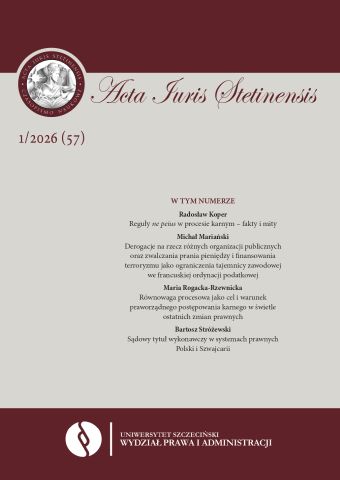
Derogacje na rzecz różnych organizacji publicznych oraz zwalczania prania pieniędzy i finansowania terroryzmu jako ograniczenia tajemnicy zawodowej we francuskiej ordynacji podatkowej.
(Derogations in favor of various public organizations and the fight against money laundering and terrorism financing as limitations on professional secrecy in the French tax code.)
DOI: 10.18276/ais.2026.57-03
Cite
The full text is available
| ISSN: | 2083-4373 |
| eISSN: | 2545-3181 |
| Authors: |
Michał
Mariański

Uniwersytet Warmińsko-Mazurski w Olsztynie |
| Keywords: | fiscal secrecy French law tax ordinance tax law comparative law |
| Issue / book publication date: | 2026 |
| Page range: | 17 (37-53) |
| OAI-PMH: | Metadata |
| Klasyfikacja JEL: | K34 K23 |
| Downloads ?: | 156 |

 

 
| |
Abstract
The constant evolution of tax law regulations means that in the era of globalization and internationalization of economic relations, research studies on laws of foreign countries are becoming increasingly important. Thus, the method of regulating inclusions in the scope of fiscal secrecy may be one of the areas of such investigations, where French law can provide an interesting comparative background for other legal systems. The above results not only from the specificity of French law but also from the very extensive catalog of inclusions and division into many groups introduced by the French legislator. The aim of this article is to assess the way of introducing inclusions in fiscal secrecy in relation to two of the eight groups that was listed in French law. To do so, the author relies on investigation of the law in force, the descriptive research method and the functional com¬parative method. The first group includes the so-called various public bodies, and the second group refers to money laundering and terrorism financing. Additionally, the author tries to draw conclusions as to the justification and possibility of the Polish legislator following the French regulations in this aspect. The conclusions will also include specification and assessment of specific measures laid down in the French tax ordinance.
Preview PDF
Bibliography (27)
- Babiarz S., Dauter B., Gurba W., Hauser R., Kabat A., Olesińska A., Rudowski J., Niezgódka-Medek M., Ordynacja podatkowa. Komentarz, Warszawa 2024.
- Błaszko A., Organizacja samorządu terytorialnego oraz nadzoru nad samorządem we Francji, „Finanse Komunalne” 2019, nr 6.
- Caillaud P., Devenir une organisation représentative au niveau national interprofession-nel. Les enjeux juridiques de l’action des employeurs de l’économie sociale, „Travail et Employ” 2012, n° 3.
- Caron E., Le Big Data fiscal: quelles conséquences pour le contrôle fiscal et les contribuables?, „Gestion & Finances Publiques” 2021, n° 6.
- Chevalier J.-P., Confidentialité et droit fiscal, „Revue Internationale de Droit Comparé” 1998, vol. 50, n° 2.
- Chmielarz-Grochal A., Francuska Rada Stanu jako „sąd nad prawem”, „Państwo i Prawo” 2014, nr 7.
- Delaunay B., Le secret administratif, „Titre VII” 2023, nº 11.
- Gliniecka J., Wyjątek od zasady tajemnicy skarbowej czy zaprzeczenie jej istoty?, „Prawo i Podatki” 2007, nr 3.
- Kędzierski M., Rola izby rozliczeniowej we wspieraniu instytucji obowiązanych na pod-stawie przepisów art. 119zu § 2a pkt 1 ustawy Ordynacja podatkowa – w zakresie przeciwdziałania praniu pieniędzy oraz finansowaniu terroryzmu (część 1), „Prokuratura i Prawo” 2024 , nr 5.
- Kmieciak Z., Rady stanu we współczesnych systemach sądownictwa administracyjnego, „Państwo i Prawo” 2010, nr 9.
- Kwaśniak A., Faktyczne i prawne ograniczenia w dostępie do informacji publicznej na tle rodzimego ustawodawstwa, „Roczniki Administracji i Prawa” 2019, nr 2.
- Lamy V., L’équilibre de l’abus de droit en matière fiscale: entre insécurité juridique objective et recherche de confiance légitime, „Revue du Droit Public” 2021, n° 5.
- Machowska A., Postępowanie cywilne, w: A. Machowska, K. Wojtyczek (red.), Prawo francuskie, t. II, Kraków 2005.
- Mariański M., Instytucje konsultacyjne wspomagające pracę organów nadzoru nad rynkiem finansowym we Francji, „Przegląd Ustawodawstwa Gospodarczego” 2023, nr 11.
- Mariański M., Uprawnienia i kompetencje francuskiego pomocniczego organu nadzoru nad rynkiem finansowym Autorité de contrôle prudentiel et de résolution, „Przegląd Prawa Handlowego” 2023, nr 4.
- Mariański M., Wyłączenia na rzecz komisji, organów sądowych i sądów jako jeden z elementów kształtowania zakresu tajemnicy skarbowej we Francji, „Opolskie Studia Administracyjno-Prawne” 2025, nr 1.
- Mariański M., Piechota-Oloś E., Prawno-porównawcze aspekty regulacji zakresu tajemnicy skarbowej, „Studia Prawnoustrojowe” 2025, nr 68.
- Nowak I., Ujawnienie tajemnicy skarbowej na podstawie artykułu 299b Ordynacji podatkowej, „Prawo Budżetowe Państwa i Samorządu” 2021, nr 1.
- Pikuła Ł.J., Metody wykładni prawa stosowane przez Trybunał Sprawiedliwości Unii Europejskiej, „Przegląd Prawno-Ekonomiczny” 2016, nr 3.
- Pilotin J., Le secret en matière fiscal, Paris 2022.
- Rogowski Ł., Czy w dobie pandemii można telefonicznie udzielać informacji objętych tajemnicą skarbową?, „Przegląd Podatków Lokalnych i Finansów Samorządowych” 2021, nr 6.
- Stachurski W., w: L. Etel (red.), Ordynacja podatkowa, t. II, Procedury podatkowe. Art. 120–344. Komentarz aktualizowany, LEX/el. 2024.
- Szubiakowski M., Problemy prawnej regulacji tajemnicy skarbowej, „Zeszyty Naukowe Sądownictwa Administracyjnego” 2014, nr 4.
- Ury D., La discrétion fiscale, une obligation déontologique majeure dans le contexte de la mise en place du prélèvement à la source, „Gestion & Finances Publiques” 2017, nº 1.
- Vassiliou P., Stosowanie Karty Praw Podstawowych UE przez sądy francuskie – Radę Stanu i Sąd Kasacyjny, „Europejski Przegląd Sądowy” 2016, nr 8.
- Verdier P., Secret professionnel et partage des informations, „Journal du Droit des Jeunes” 2007, nº 269.
- Zalewski D., Naruszenie tajemnicy skarbowej a legalność postępowania podatkowego, „Monitor Podatkowy” 2019, nr 11.